Pressures have shifted upstream as process intensification is used throughout biologics manufacturing. The N-1 stage — the final expansion step before production — is now in focus.
Process engineers are turning to N-1 perfusion to seed production bioreactors at higher densities. This approach shortens timelines but also introduces new challenges. Media exchange and cell concentration at this step can strain legacy tools, especially when cell densities climb and automation is required for cGMP readiness.
Traditional filter-based systems like tangential flow filtration (TFF) and alternative tangential flow (ATF) often can’t keep up at high cell densities. In-situ bioreactor exchange (BRX) methods are also used in development labs, and while these workflows work well at low volumes they don’t scale for GMP manufacturing. GMP demands for increased cell densities have turned the N-1 stage into a proven strategy for process intensification.
To see why this stage matters, it helps to define what N-1 perfusion is — and what it enables.
N-1 Perfusion Basics: Why It's Critical
N-1 perfusion is the media exchange performed during the final expansion stage of the seed train. By refreshing nutrients and removing waste while retaining cells, teams can drive higher cell densities before inoculating the production reactor. Unlike membrane-based systems, the UniFuge® performs the media exchange through gentle centrifugation.
Typical targets at this stage reach up to 100 million cells/mL. Reaching these densities allows for:
Higher seeding densities accelerate production starts by enabling the production bioreactor to reach target density sooner, reducing time to harvest and allowing more batches per month.
Healthier cells drive greater protein output because gentle handling at N-1 preserves viability, ensuring more cells remain productive and sustain consistent protein expression.
Shorter runs free up cleanroom capacity as condensed timelines increase productivity per square foot and help facilities avoid costly expansions.
The opportunity is clear, but so are the risks. At these densities, cells must be handled gently to preserve viability, and media exchange must be both rapid and closed to support GMP compliance. These demands expose the limits of traditional tools and highlight the need for dependable, predictable solutions.
Where ATF and TFF Break Down
Alternating tangential flow (ATF) and tangential flow filtration (TFF) systems are the most common tools for N-1 media exchange today. They work, but their trade-offs worsen as cell densities climb.
Setup and complexity: ATF/TFF systems create a heavy burden for PD and manufacturing teams. System preparation can take three to five hours including setup, filter wetting, and integrity testing. The learning curve, consumables management, and long setup cycles make them difficult to implement.
Consumables cost: Each run can require tens of thousands of dollars in disposable modules and filter assemblies.
Fouling and clogging: High cell densities (above ~50M cells/mL) increase the risk of filter fouling, which can compromise runs and add variability.
Manual centrifugation or open processes may suffice in development labs, but they don’t scale into GMP manufacturing where closed, automated solutions are mandatory.
What's Needed in an N-1 Concentration Solution
At the N-1 stage, concentration goes beyond simply moving cells from point A to point B. The way cells are conditioned here can influence the productivity and consistency of the production reactor that follows. Poor handling can cause hysteresis effects — where stress at N-1 carries over and impacts growth, viability, and protein expression in the N stage.
A modern solution must provide:
Versatility to handle diverse seed train formats — different cell lines, volumes, and densities.
Low shear to preserve viability and keep cells “happy”, ensuring they thrive when inoculating costly fed-batch or larger perfusion runs.
Automation and recipe-driven control for consistent, low-touch concentration.
Closed, single-use operation to eliminate cleaning validation and support fast, GMP-compliant changeovers.
In short, the right system has to balance cell protection with operational efficiency, ensuring that the gains from N-1 intensification aren’t lost in the transition to production.
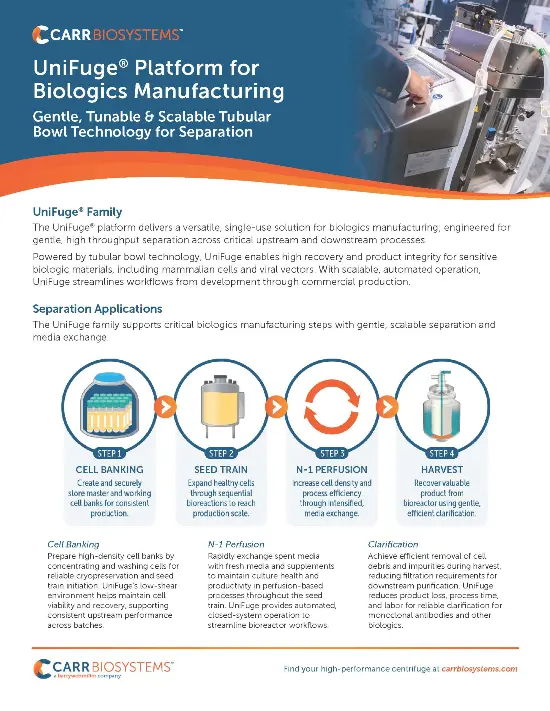
The UniFuge system uses a tubular bowl centrifuge design to gently capture cells and remove spent media. This closed, automated process maintains high cell densities during discharge, reduces contamination risk, and accelerates seed train turnarounds.
How UniFuge fits depends on the facility. Some teams position it as a replacement for TFF in N-1 media exchange, simplifying workflows and reducing consumables. Others integrate UniFuge alongside ATF as part of a hybrid strategy, using UniFuge for final concentration and buffer exchange before inoculation. Either way, the goal is the same: reduce risk, preserve cells, and streamline the path into production.
How the UniFuge Family Supports N-1 Intensification
The UniFuge family is built for N-1 intensified media exchange. It processes high-density cultures — up to 100 million cells/mL — with 98% recovery and 95% viability, ensuring production reactors are seeded with dense, healthy cells.
Closed, single-use kits cut contamination risk and cleaning validation, while automation reduces operator variability. Results are consistent from PD through GMP.
Scalability is built into the UniFuge family: UFMicro (<1 L), UFMini (10–20 L), and UFPilot (>100 L) use the same bowl design and control logic, so parameters carry forward without re-engineering. The platform supports fed-batch and perfusion bioreactors alike, simplifying N-1 while protecting cells and accelerating the seed train.
Real-World Use Cases in N-1 Perfusion
Use Case 1: Mid-scale biotech intensifying mAb production
A biotech group used UniFuge to concentrate N-1 perfusion cultures at 80 million cells/mL. The closed, single-use workflow reduced cleaning validation burden compared to TFF and simplified media exchange.
Use Case 2: CDMO standardizing across clients
A CDMO implemented UFMini for N-1 perfusion media exchange and buffer replacement across multiple cell lines. The platform provided consistent performance and reduced variability across diverse client programs.
Removing a Critical Bottleneck in Upstream Intensification
Seed train intensification is a proven strategy for process intensification. By reaching higher cell densities at N-1, teams shorten time to harvest, enabling faster runs and greater output per cleanroom square foot, without expanding facility footprint.
UniFuge delivers these gains by supporting dense, low-shear cell concentration in an automated format. Recipe-driven control and simple setup reduce operational burden and streamline workflows for fast, consistent performance.
For facilities scaling production without added complexity, N-1 is the next place to optimize, and UniFuge provides a proven path forward.
Learn how UniFuge® simplifies N-1 perfusion with closed, low-shear concentration at high cell density to help your team accelerate seed trains and scale production with confidence.