SAME CONCENTRATION TARGET, A DIFFERENT VOLUME EVERY BATCH
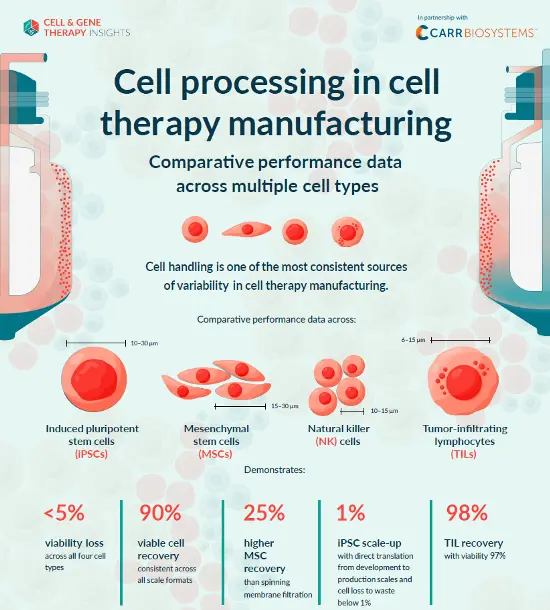
At the end of a concentration step, process development teams judge success first by recovery and viability: how many cells came through the step, and how many are still healthy. Together, those set the viable cell count. The volume those cells end up in sets the concentration, and concentration determines what the next step can do, whether that’s dosing, cryoprotectant introduction or another unit operation.
On many systems, though, the output volume is fixed by the equipment rather than defined by the process. Final volume should be managed like any other critical process parameter: defined for each step, controlled by the recipe, and adjusted as the process demands.
Why concentration targets push teams onto two systems
As programs move toward the clinic, concentration targets tighten. A concentrate that’s too dilute can miss the dose or start cryopreservation outside its target range. When the harvest system can’t reach a low enough volume, teams add a step: reduce volume on one system, then transfer to a second, smaller-scale device for final concentration. That second system brings another transfer, another handoff, and its own qualification, training and consumables.
Upstream variability makes it harder. Source material varies by patient in autologous processes and by donor in allogeneic ones, and expansion yields change from run to run. The volume needed to reach the same concentration changes with them. Final volume is a variable, not a constant, so the useful question is whether the system lets the process set it for each run.
The cost of a fixed volume
Besides a second system, the usual workarounds are familiar: over-concentrating and diluting back in a separate container, finishing the reduction by hand at the bench in an open, operator-dependent step, or accepting a more dilute product and adjusting downstream. Each is reasonable on their own. However, together they add time, handling, and variability at the point where cells are most concentrated and most valuable, and they let equipment limits shape the process.
How Target Concentrate Volume works
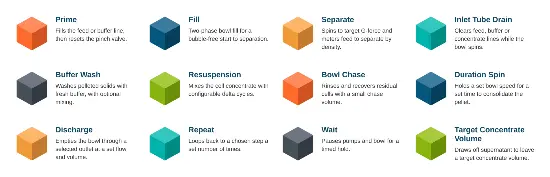
The UniFuge Mini (UFMini) is a closed, low-shear, continuous centrifugation platform used in from process development through GMP commercial supply. Its modular recipe management system builds recipes from configurable functions, and Target Concentrate Volume (TCV) is one of them.
TCV builds on the separation the UFMini already performs. During separation, the bowl spins at a set speed and cells are pelleted against the wall, separated from the supernatant, as shown in Figure 1.
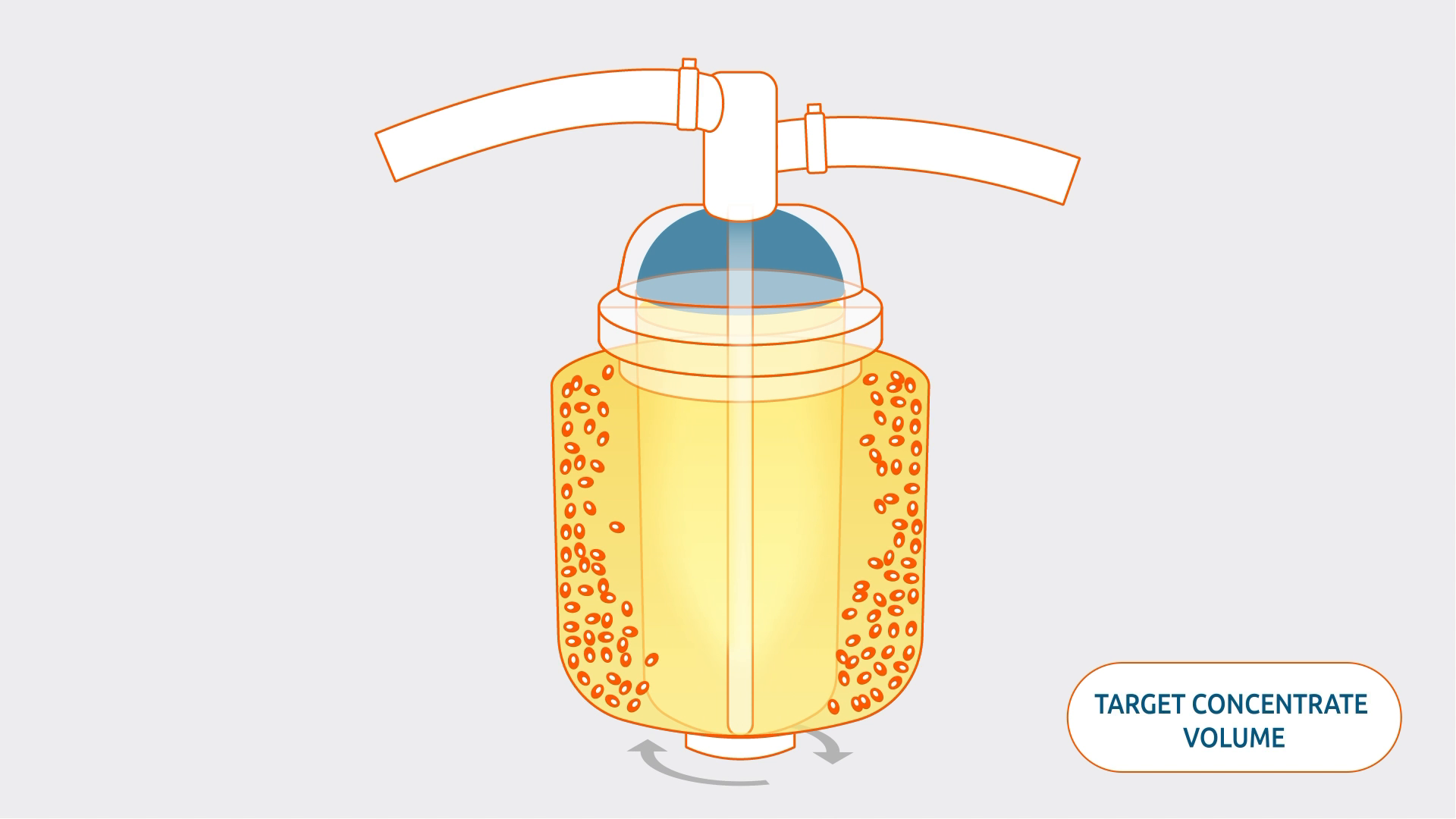
Figure 1: At separation speed, cells are held against the bowl wall, separated from the supernatant.
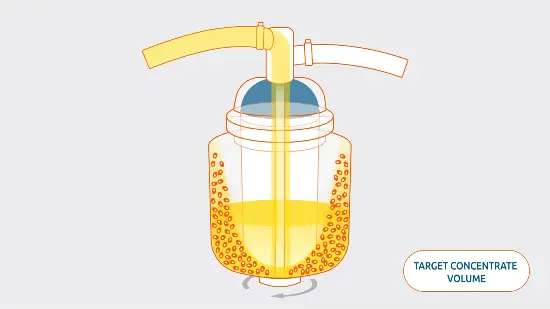
TCV then lowers the bowl speed gradually. At the lower RPM, the liquid in the bowl takes on a parabolic profile, so supernatant can be removed while the cells stay pelleted, as seen in Figure 2.
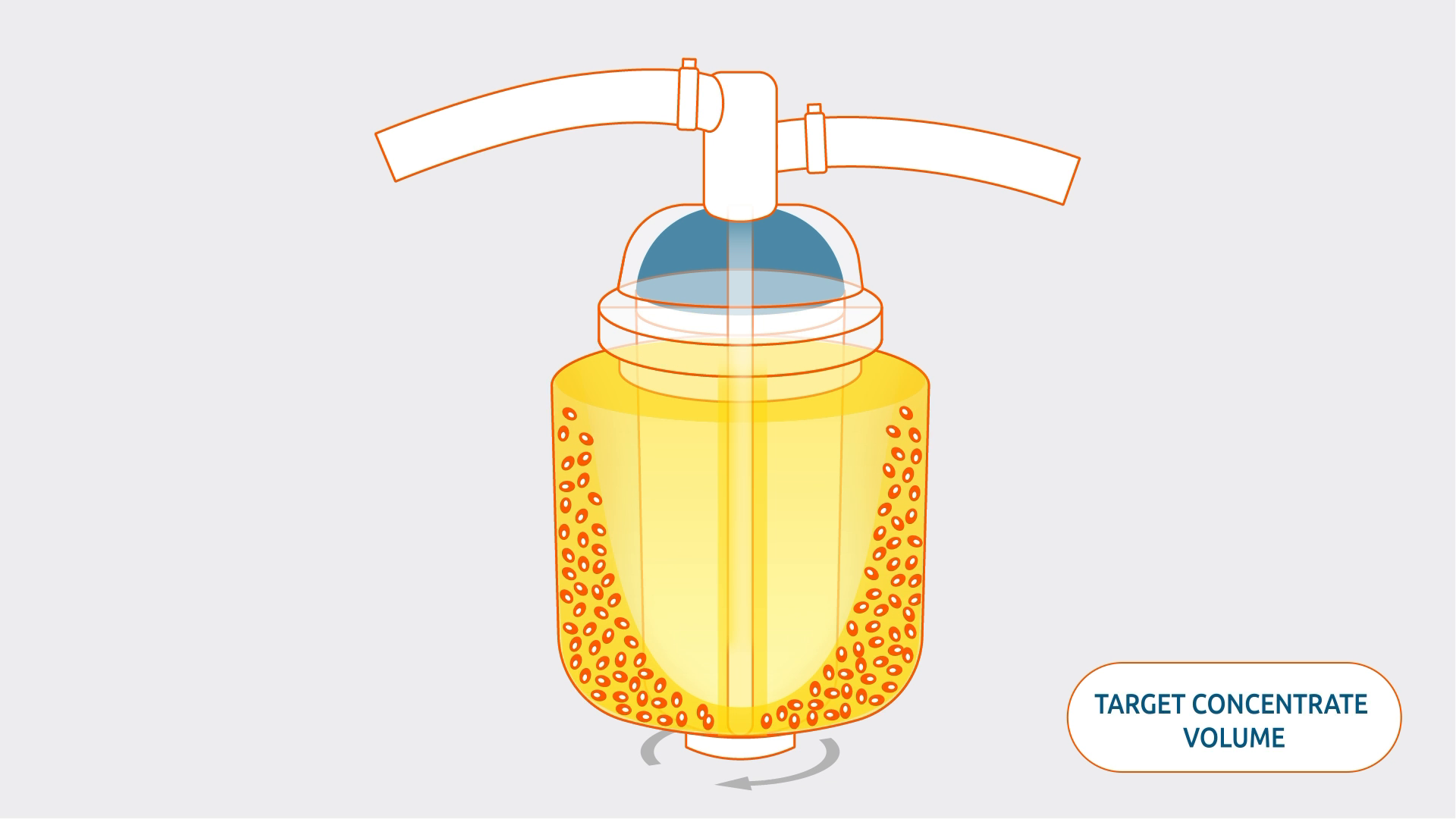
Figure 2: At lower RPM, the cells remain pelleted while the liquid forms a parabola.
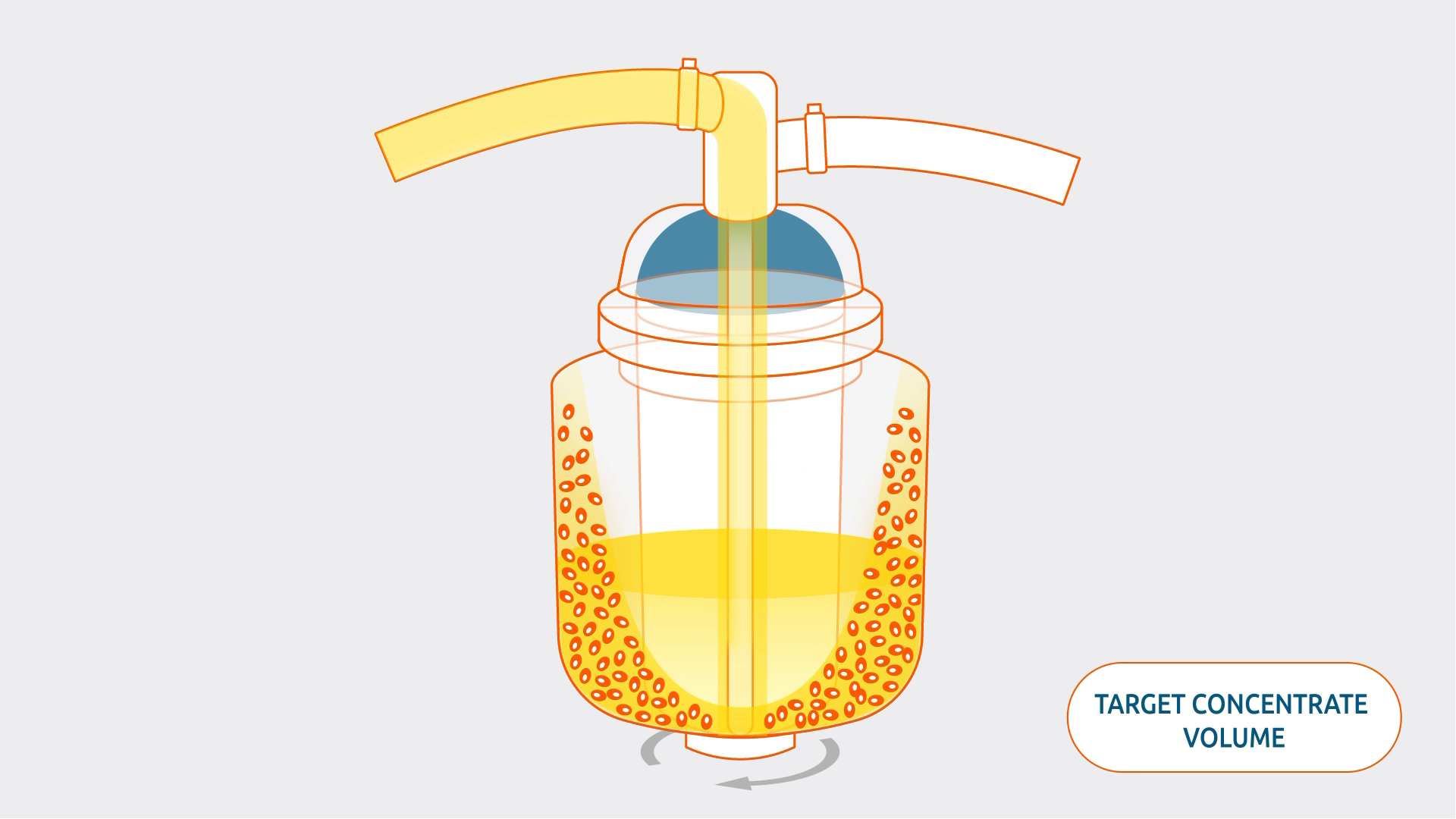
After the pump draws off excess suspension fluid until only the target volume remains, as shown in Figure 3.
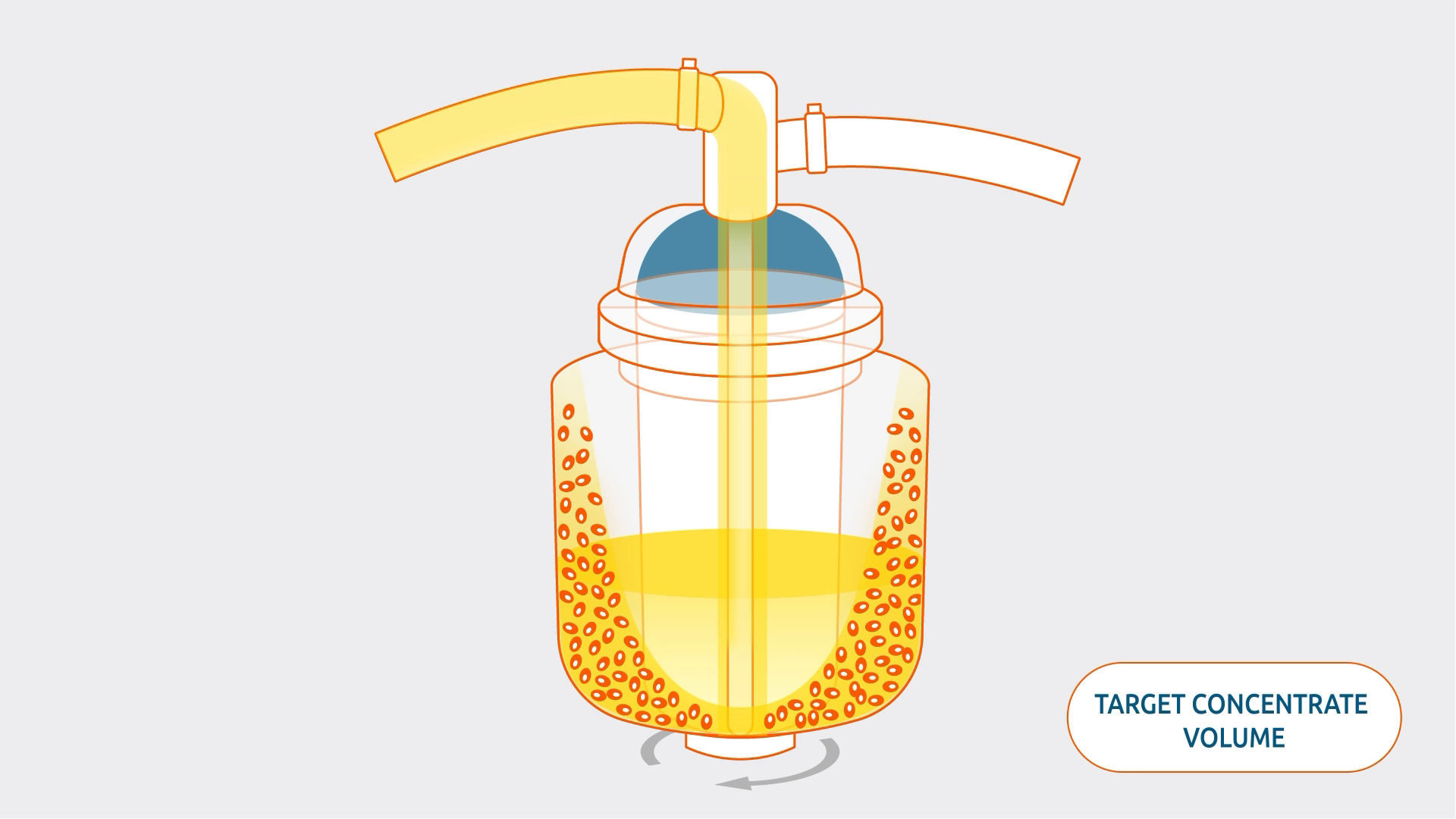
Figure 3: Excess suspension fluid is removed until the target volume remains.
The target is set in the recipe, down to 50 mL,* extending UFMini’s range below the 300 mL previously available while keeping the volumes it already covers.
Since TCV is a recipe function, it goes wherever the process needs it: after separation, after a wash, or before media, reagent or cryoprotectant introduction. Changing the target is a recipe edit, and recipes can be saved as separate versions, so a team can keep a standard-volume recipe alongside a lower-volume one.
See TCV in action: watch the explainer video → [link to Flikli explainer video]
Where TCV fits in a process
Concentration set for the next step. Teams know the concentration the next step needs. With TCV, the volume to reach it is defined in the recipe rather than by operator technique, which supports consistent CQAs and CPPs. Teams that prefer to over-concentrate slightly and dilute back to target (you can always dilute, but you can’t undo it) can still do so, with both steps in the same recipe and the same closed system.
Different source material, different volume. When a patient or donor yields more or fewer cells than the last run, final volume is adjusted for that run in the recipe. In autologous processes, that flexibility becomes part of the standard process rather than an exception.
Ahead of cryoprotectant introduction. Reducing volume with TCV before cryoprotectant is added lets pre-formulation start from a smaller, controlled volume within the same closed run.
Scaling up and back down. Allogeneic teams often run smaller studies early in development or during optimization to conserve media and cells, and a low expansion yield can force the same. TCV lets those runs proceed at variable volumes on the same platform, so what’s learned at small scale carries forward.
Already running your UFMini?
Modular recipes and TCV are available as an upgrade installed during a field service visit, adding the lower volume range while keeping the existing one. Your CARR representative can review the details for your equipment.
Concentration defined by the process
On a system with a fixed output volume, the equipment partly decides the concentration and the process adapts to it. With TCV, final volume becomes a recipe setting, and control stays with the scientists developing the process.
See how Target Concentrate Volume can fit your workflow → Learn More
* Process-condition dependent.